
Talking to Young Kids About AI - Digital Literary for Kids

TLDR:
Resources for the Grown Ups Navigating AI with Kids
Watch AI Simply Explained In 12 Minutes from Future with Fawzi
Check out Common Sense Media’s safety ratings for dozens of AI tools for kids
Read Media Smart’s Talking to Kids About AI: Tips for Parents
Teaching Kids How ChatBots Learn and Write
Watch What is an LLM? from Mr. Vullo
Pretend to Train a Baby Chatbot from STEM Through Story and Play
The constant AI chatter in the news and on our social media feeds is a lot right now. How the heck do we talk about this stuff with our kids? Keep reading and let me walk you through it.
Teaching to Young Kids About AI - Digital Literacy for Kids

It seems like AI is all over my news feed, my podcast feed, my social media feed. I’m sure you’re feeling it too - the swirl of controversy and uncertainty. So what do we do with all that uncertainty when it comes to our kids and AI?
With preschool and elementary age kids, my gut instinct is to just avoid them interacting with AI as long as I can! But is that realistic, in a world where already the top Google search result is an AI summary?
Still, I don't think you need to teach your kid to use AI. (For what it's worth, Common Sense Media recommends that elementary age kids should have limited access to AI, and only with parental supervision.)
I do think our kids need to learn to think critically about AI tools and their outputs.
How do we teach them? I’ve put together a guide, and this is just part 1 - helpful resources to get parents & educators quickly up to speed, and then resources that explain how AIs learn in an accessible kid way. Keep reading, let’s do this together.
(Just a reminder - I am never paid to mention any of these resources; there are no affiliate links.)
Resources for Parents & Teachers
from Future with Fawzi
First of all, if you’re really overwhelmed just trying to understand AI yourself, this 12 minute video explains AI and data centers using mostly non-technical language and clever little illustrations. Honestly you do not need to understand most of the details in this video (like the difference between predictive, generative, and agentic AI) in order to talk to your kids or facilitate any of the activities I’m going to recommend. But watching this may make you feel more comfortable just engaging with this topic at all. And this may be a good video to share with teens in your life who have questions about AI that you don’t know the answer to.
Now, on to the best practices spec kids about AI. Some of the articles I link here are geared more towards teens, but many experts are recommending that we should be starting conversations as early as elementary school age.
Here are recommendations I saw come up over and over:
Explore AI together. This gives you oversight, but also provides opportunities to prompt kids to think critically about their AI experience. Ask questions about whether the AI was helpful, what parts felt off, where you think the information came from.
Teach kids to think critically about the answers that AI provides. Teach them to double-check with trustworthy sources of information, and teach them that AI is trained on datasets that can contain inherent biases.
The nonprofit Media Smarts recommends that parents keep their children’s personal information from being collected by AI. For example, check the AI chatbot settings to make sure your kids’ questions to AI are not saved and used to train the AI.
The nonprofit Common Sense Media has safety ratings for dozens of AI tools used by kids. As of September 2026, almost all of the AI tools in this list are rated between “moderate risk” to “unacceptable risk.” (One notable exception, they do rate Khan Academy’s tutoring chatbot as “low risk.”)
One more aside for parents and teachers of teenagers, here are a few other resources that I recommend:
NPR’s LifeKit recommends talking to teens about the risk of misinformation especially around mental health, substance use, body image and risk-taking behaviors.
MIT Technology Review recommends talking to teens about the AI recommendation algorithm’s profit motives, and the risk of teachers accusing students of using AI when they haven’t.
This teacher’s 3 minute video has a great explanation for why teens shouldn’t be using AI to learn for them.
Now that you’re prepared with the current best advice out there for parents and teachers, let’s get to how to actually start that conversation with kids.
Teaching Kids How ChatBots Learn and Write
First watch What is an LLM? Simple AI Explanation for Kids & Beginners (5+ Years Old) from Mr. Vullo
As the title says, this is a simple explanation video that compares AI’s to parrots. A parrot that has read a ton of books and articles, and then uses what it learned to guess what the next word in a sentence might be.
This parrot analogy is so accessible for kids, but I also wanted an interactive activity to will really give kids something tangible to wrap their brains around. That’s why I put together this next activity.
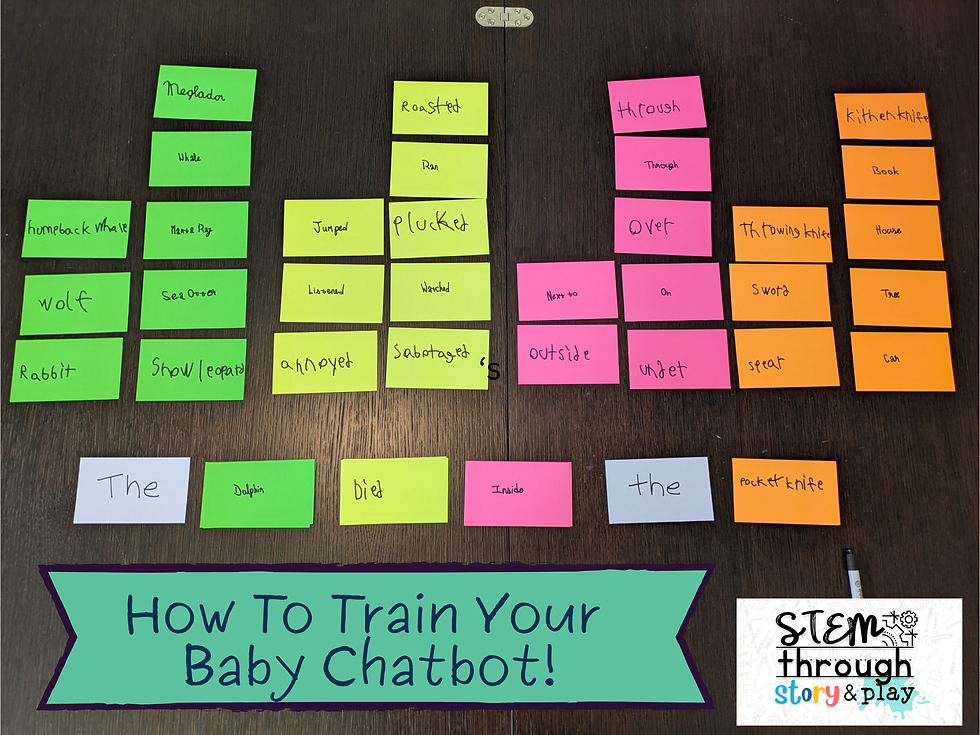
from me - STEM through Story and Play
This is a fun roleplay game that requires zero screens, zero use of AI. Just a lot of great human imagination! It works for a big group of kids in the classroom, or one of two kids at home. As long as they’re old enough to play Mad Libs, they can “train” a Baby Chatbot.
Once you’ve trained the Baby Chatbot to write a sentence, this gives you concrete example to kick off conversations about what AI knows, doesn’t know, feels, and doesn’t feel.
As I said before, this is just part 1 of a series. Part 2 is coming soon, including more games all about the limitations of AI and the dangers of misinformation. Sign up for my monthly emails so you don’t miss part 2! We can teach our kids what they need to know, together.
Until next time,
Amy Wung Tsao


Comments